Education

A flyer that reads, 'Understanding NSF Emails and UKVI Credibility Interviews'

Understanding NSF Emails and UKVI Credibility Interviews

All You Need to Know About NSF Emails and UKVI Interviews Starting your UK study journey is exciting, but the visa application process can sometimes be overwhelming—especially when you come across an unexpected roadblock, like an NSF (Non-Straight Forward) Emails or a UKVI  interviews. NSF Emails or a UKVI interviews If you’re currently in the process of applying for your UK student visa, or have already received an NSF email, this guide is here to provide clarity. Whether you’re preparing your documents, waiting for a decision, or even gearing up for a visa interview, understanding these key processes will help you avoid common mistakes and ensure a smoother visa experience.   What is an NSF Email? An NSF (Non-Straight Forward) is an automated email you get from the UKVI requesting further verification.  If your application raises questions or doesn’t fully meet the requirements, you will receive an NSF email notifying or requesting additional documents from you.    Common Reasons for Receiving an NSF Emails Several factors can trigger an NSF email. These include: Incomplete or Illegible Documents: Missing or unclear documents can delay your application. Old Bank Statements: If the financial proof you’ve submitted is more than 30 days old at the time of application, UKVI might request a more recent one. Unexplained Transactions: Large inflows in your bank account can raise concerns and require further explanation. Work/Study Gaps: If there are unexplained gaps in your academic or work history, you may be asked for evidence of activities done during this period. Proof of English Language: Not uploading the proof of English proficiency that is listed in your CAS document could lead to an NSF email. Course Mismatch: Applying for a course unrelated to your previous studies or work experience might lead to further questioning. To avoid NSF emails, be sure to thoroughly check your visa application for errors or missing information. At Negxy Concept Limited, we can help you with a visa document checklist and guide you through the entire visa process to minimise these risks.   What Are Empty NSF Emails? In some cases, you might receive an Empty NSF Email. These emails don’t ask for additional documents or interviews but indicate that UKVI needs more time to process your application. Reasons for receiving an empty NSF email include: Administrative Processing: If UKVI can’t finish processing your application within their standard time frame, you might receive this email. Document Verification: They may be verifying your submitted documents, such as bank statements or references. If you receive an empty NSF email, there’s no immediate action required. However, staying updated on your application status is crucial. Check your email regularly to see if any further steps are needed.   What Triggers a UKVI Interviews? If UKVI remains uncertain about parts of your application after receiving the required documents, you could be invited to a credibility interview. This interview is a key part of the visa application process and helps UKVI verify the details of your study plans, financial situation, and background.   Why You Might Be Called for an Interview Course/Work Mismatch: If the course you’re applying for doesn’t seem to match your previous education or work experience, you might be asked to justify your choice. Visa Rejections: Previous visa rejections from the UK or other countries may trigger an interview. Inconsistent Information: Any inconsistencies between your current and previous visa applications can lead to further questioning. Source of Funds: Be prepared to explain the source of your funds, especially if there are large or unexplained transactions in your bank statement. For a comprehensive guide on what to expect during a UKVI credibility interview and how to prepare, check out our instagram live session on how to tackle NSF Emails and Visa Interviews for UK Study Visa Applications.   How to Prepare for a Credibility Interview Receiving an interview invitation isn’t the end of the road—it’s simply a chance to clarify your application and demonstrate your intentions. To prepare, make sure you: Review all the details in your visa application. Be ready to discuss your study plans, financial backing, and how your course aligns with your future goals. Practice answering common interview questions, such as why you chose your course and how you plan to fund your studies. At Negxy Concept Limited, we offer personalized guidance to help students confidently prepare for their UKVI credibility interviews. If you’ve received an invitation or anticipate one, don’t hesitate to reach out for expert support.   Stay Proactive and Prepared Whether you’re about to submit your visa application, have received an NSF email, or are preparing for an interview, staying proactive and informed is essential. These processes may seem complex, but with the right support, you can overcome any hurdles.  For personalised assistance with your UK student visa application, including preparing for credibility interviews, contact us today.
Read More
A flyer that reads, All You Need to Know About the UK E-Visa as an International Student

All You Need to Know About the UK e-Visa as an International Student

Transitioning to the UK E-Visa for International Students As you prepare to start your studies in the UK this September 2024—or if you’ve recently arrived—there’s an important update you need to be aware of. The UK is transitioning from physical Biometric Residence Permits (BRPs) to a fully digital immigration system called an e-Visa. Whether you’re a prospective student or someone who travelled in previous intakes, understanding this change is crucial for managing your immigration status. What Is a Biometric Residence Permit (BRP)? For those new to the UK or planning to study here, a Biometric Residence Permit (BRP) is a document that has been traditionally issued to international students. It contains vital information such as your name, date of birth, and biometric details like fingerprints and facial images. The BRP also serves as proof of your right to study and access certain public services in the UK. However, as the UK modernizes its immigration system, these physical BRP cards will be phased out by December 31, 2024. Understanding this shift is essential whether you’re just starting your academic journey or have already settled in.   Introducing the UK e-Visa: Your New Digital Immigration Status The eVisa is the future of UK immigration. Instead of carrying a physical BRP card, your immigration status will now be stored digitally. This eVisa is an online record that you can easily access to prove your right to study, work, or rent in the UK. For prospective students, this means that once you receive your visa approval, you will manage your immigration status through an online account rather than waiting for a physical BRP. Current students, especially those with BRPs expiring soon, will need to transition to this new system. For more details on the eVisa, visit the UK government’s eVisa page.   Why Physical BRPs Are Being Replaced As part of its digital transformation, the UK government has decided that all physical BRPs will expire by December 31, 2024, regardless of the original end date on the card. This move is aimed at improving efficiency and security, making it easier for international students like you to manage your immigration status. If you currently have a BRP, it’s important to begin the transition to a UK e-Visa by creating a UK Visa and Immigration (UKVI) account. This digital account will become your primary means of proving your immigration status.    Transitioning to the UK e-Visa: What You Need to Do Whether you’re a prospective student preparing to arrive in September 2024 or a current student already in the UK, transitioning to an eVisa is straightforward: Set Up a UKVI Account: This account is where you’ll access and manage your eVisa. Click here to get started. Verify Your Identity: Use the ‘UK Immigration ID Check’ app to confirm your identity and link your eVisa to your UKVI account. Access and Share Your eVisa: Once verified, you can view your visa details online, share your status with landlords, employers, and educational institutions, and update your information as needed. Click here to watch a step-by-step guide on how to create your UKVI account and access your eVisa.   Preparing for September 2024: Key Steps for New Students If you’re starting your studies this September, you might still receive a BRP card, but with an expiration date of December 31, 2024. Regardless of whether you get a BRP, setting up your UKVI account is crucial for managing your immigration status digitally. Pro Tip: Create your UKVI account before arriving in the UK to streamline your transition, or complete the setup as soon as possible after your arrival. For more information, visit the UKVI registration page.   Conclusion For both prospective and current students, embracing this change will make managing your visa easier and more convenient, allowing you to focus on what matters most—your studies. At Negxy Concept Limited, we’re committed to guiding you through these changes and ensuring your study abroad experience is as smooth and successful as possible.
Read More
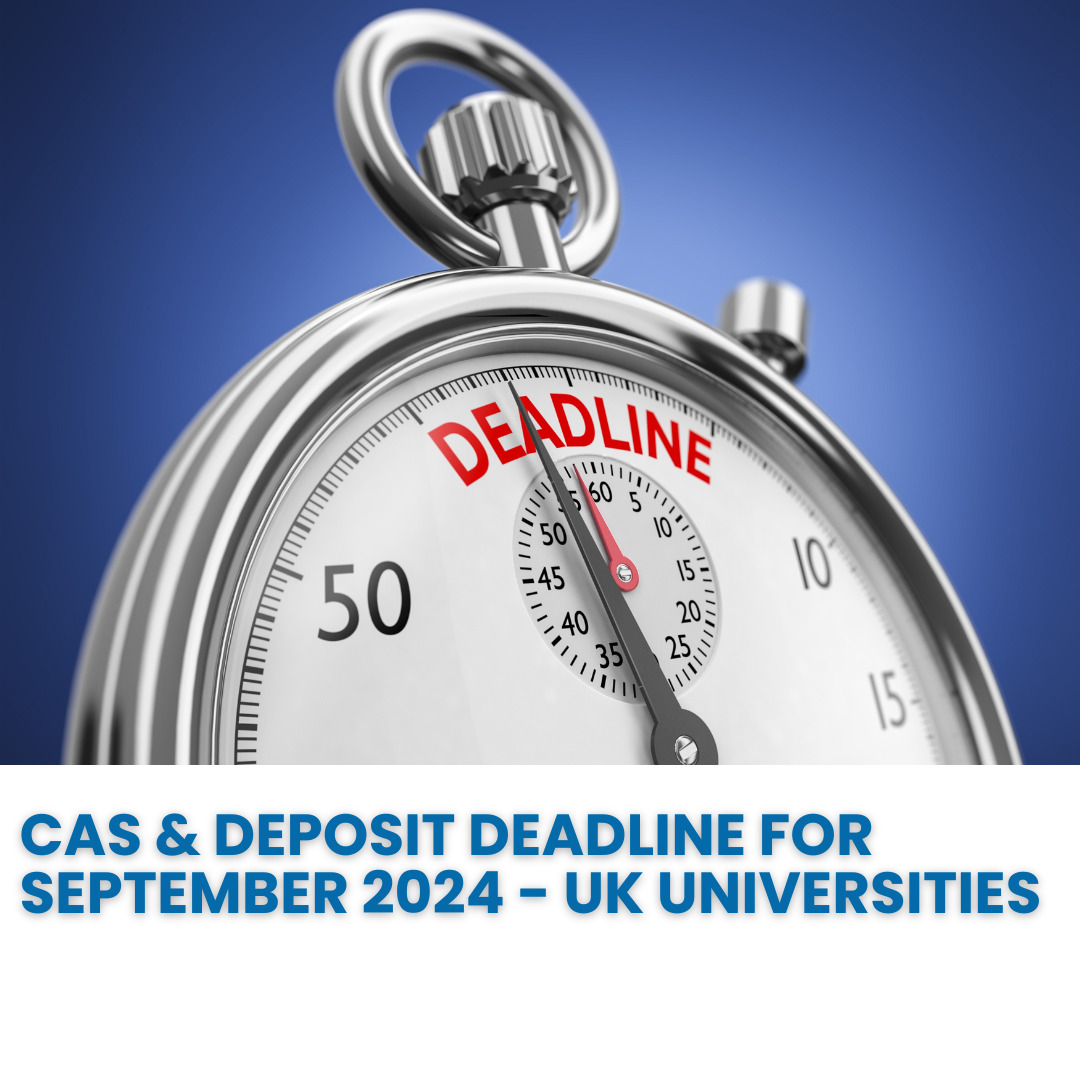
A picture that reads, CAS & Deposit Deadline for September 2024 - UK Universities 

CAS & Deposit Deadline for September 2024

CAS & Deposit Deadline for September 2024 – UK Universities  As a prospective international student looking to study in the UK, there are certain steps you should have taken before your CAS & Deposit Deadline for September 2024. If you have applied for admission either for Undergraduate or Postgraduate Programs then you have gotten your conditional or unconditional offer or expecting to get it soon. If you are yet to apply please see list of schools that still opened until the 1st of August. Upon getting your offer, there are certain steps you must take to progress with your application for studies. If you have a conditional offer then you should be working really fast to meet the conditions of your offer. If you have met the conditions or you have an outright unconditional offer then you should be working to make your initial deposit which would enable you proceed with the subsequent stages – which is either Pre-Cas interview or filling your Cas-shield.   Why is it important to get this done and get it done really quickly? Having unnecessary delays during this critical stage of your application process, where the September intake is drawing near, increase your likelihood of having visa delays which can lead to missing out on your resumption altogether. In this post, we have provided some popular schools and their deadlines, in order to help you plan appropriately. This is important for meeting your CAS conditions such as provision of 28 days bank statement, before the deadline as well as your visa requirements.   Understanding CAS and Deposit Deadlines Before diving into the specifics, it’s important to understand what CAS (Confirmation of Acceptance for Studies ) & deposit deadlines entail: Deposit Deadline Most universities would require an initial tuition fee deposit to secure your place in the program. This usually would be a prerequisite to obtaining your CAS deposit. 28 Days Bank Statement Many schools require you to submit a 28days bank statement as part of your requirement for visa. Knowing your CAS deadline, enables you begin your 28-day bank statement requirement on time. CAS Deadline Your CAS deadline is the last day you have in order to meet all your prerequisite conditions to receive your documents without this, you will be unable to proceed to the visa stage This guide provides a detailed breakdown of the important deadlines for several UK universities, ensuring you stay on track with your application.   CAS and Deposit Deadlines for UK Universities – September 2024 Intake University Deposit Deadline CAS Deadline Northumbria University TBD 20 August 2024 University of South Wales TBD 31 July 2024 Sheffield Hallam University 6 September 2024 11 September 2024 University of East London 17 July 2024 23 August 2024 University of Wolverhampton 2 September 2024 9 September 2024 Teesside University TBD 26 August 2024 University of Roehampton 29 July 2024 9 August 2024 Birmingham City University 16 August 2024 8 September 2024 University of Dundee 14 August 2024 (PG), 23 August 2024 (UG) 28 August 2024 (PG), 29 August 2024 (UG) University of Hull 25 August 2024 21 August 2024 Coventry University 24 August 2024 30 August 2024 De Montfort University 9 August 2024 (PG), 23 August 2024 (UG) 6 September 2024   Conclusion Staying on top of CAS and deposit deadline is vital for securing your place at a UK university. One important way to ensure that you meet all these deadlines is to regularly check the university websites and communication from admissions offices for any updates or changes to the deadlines. We understand that navigating the application process can be overwhelming, but you don’t have to do it alone. Our team is here to assist you with your UK university application, making the process smooth and seamless. We also offer free visa application assistance, ensuring that your application is completed accurately and on time. Reach out to us for expert guidance and support to make your academic journey to the UK a successful one!
Read More
A picture with multiple flags that reads, '7 Factors to Consider when choosing a country for your studies abroad'

7 Factors to Consider when Choosing a Country for your Studies Abroad

 Choosing the Best Country for your Studies Abroad The concept of studying abroad can be both enticing and daunting. However, before choosing  a country for your studies abroad, it is crucial to conduct thorough research. Numerous factors must be taken into consideration, and Negxy Concept Limited is here to assist you every step of the way. In this post, we will delve deeper into the aspects you should consider when choosing the best country for your studies abroad.   Things to Consider Before Choosing A Country     1. Education Prospects When choosing a country for your studies abroad, one of the key factors to consider is the academic reputation of its universities. It’s crucial to conduct thorough research on the educational prospects of the country as well as the specific course you’re interested in. Take a look at reviews and international rankings of both the university and the course. Look for universities that boast internationally accomplished graduates, brilliant faculty, and state-of-the-art research facilities. 2. Language of Instruction Take into account the language used before deciding on the country for your studies. While numerous universities provide courses in English you may also want to consider taking language classes or learning the native language if it is not your mother tongue. It will greatly enhance your experience and help you navigate through your academic journey and everyday adventures. 3. Cost of Living and Tuition Fees When considering studying in a foreign country, it is crucial to take into account the overall cost of living and tuition fees. Studying abroad can be quite expensive, so it’s important to weigh the living expenses and tuition fees. Keep in mind the return on investment for your education and determine if it is worth it. 4. Adaptability Another important factor to consider when choosing a country for your studies abroad is the adaptability. Take a look at the culture and lifestyle of the country and see how well you can adjust to it. Are you open to trying new foods and adapting to different climates and cultures? If not, it’s important to choose a country that will allow you to adapt easily. Studying abroad is not just about academics; it’s an opportunity to fully immerse yourself in a foreign culture. Make sure the cultural environment aligns with your personal preferences and values. 5. Career Opportunities Research the career opportunities in the country you are considering. Some countries have more lenient work permit policies, which can provide valuable job experience during or after your studies. Your choice may be influenced by the employment market and available prospects, especially if you plan to stay in the country after graduation. 6. Safety and Quality of Life Consider the overall safety and quality of life in the country. Take into account social services, healthcare, and safety measures. It’s important to select a country where you feel safe, so consult travel advisories and safety records. This is a major factor in ensuring a successful and enjoyable study abroad experience. 7. Immigration Rules Don’t forget to check the immigration rules and regulations of the country, as well as the visa requirements. Some countries have stricter immigration procedures than others.   In conclusion, selecting a country for your study abroad experience is a complex decision that demands thoughtful evaluation of academic, cultural, financial, and personal aspects. By dedicating time to ponder your options and conducting thorough research, you will be better equipped to embark on a rewarding international educational journey. Once you have made your decision on the ideal country for your studies abroad, you can count on us to assist you with the admission process and provide expert guidance. We are here to support you every step of the way. If you have any further inquiries about this topic or if you would like to work with us, please don’t hesitate to leave a comment below! We are more than happy to help.
Read More
A Picture that reads; How to navigate non-straight forward emails from the UKVI

Navigating Non-Straight Forward Emails from UKVI

 How to Navigate Non-Straight Forward Emails from UKVI Dealing with Non-Straight Forward Emails from UKVI can be a challenge during the UK study visa application process. These emails are usually sent to inform you of problems with your application that require attention. In this post, we will explain what NSF emails are, who receives them, common reasons for receiving an NSF email, what documents might be requested, and most importantly, how to avoid receiving one during your UK study visa application process. In addition, we will explain how collaborating with a visa consultant like Negxy Concept Limited can significantly improve your chances of success.   What Are Non-Straight Forward Emails? An NSF Email, short for Non-Straightforward Email, is a message sent by the UKVI when they notice a problem with your UK visa application. There are two primary types: 1. Processing Delay NSF Email This type of Non-Straight Forward Emails from UKVI  informs you of the high volume of applications that the UKVI is dealing with at the time and the potential processing delays this may cause for your UK study visa application. Unfortunately, there’s little you can do but wait for the decision. 2. Application Issue NSF Email It email is sent when the UKVI encounters a problem with your UK study visa application. Common reasons for this type of NSF email include problems with your immigration history, incomplete or illegible documentation, or doubts about your intentions for travelling.   Common Reasons For Receiving a Non-Straight Forward Email?   There are a variety of reasons to receive Non-Straight Forward Emails from UKVI, some of which include; Incomplete Application Sometimes, applicants may unintentionally leave out required information or documents when submitting their UK study visa application. The UKVI may request additional documents to ensure they have all the necessary information to make a decision. Document Verification The legitimacy of the documents you provided might need to be confirmed by the UKVI.               This can entail getting in touch with the issuing authorities or running more checks. Change in Circumstances The UKVI may require new information or documentation to evaluate your eligibility if your situation or immigration laws have changed since you submitted your UK study visa application. To Request an Interview An NSF email inviting someone to a live or virtual interview may also be sent to a visa applicant. This generally happens when there has been a visa denial or ban or if there has been a recent marriage of less than two years. This interview’s objective is to confirm that you are actually going on this trip for the reason you claimed in your visa application.   Documents the UKVI Might Request you to Provide in an NSF Email In the event of an NSF email regarding your UK study visa application, the UKVI may request specific documents, such as: Proof of Relationship If you’re in a recent marriage, you may be asked to provide photos of you and your spouse before your wedding, both alone and with family. Older photos are preferable. Chat history from when your relationship began can also serve as evidence. Joint ownership of property can further support your case. References You may need to provide references, especially if they were not provided during your initial application or if there are gaps in your timeline. Bank Statement A new, legible bank statement might be requested if your previous one was either unreadable, less than 28 days, or was printed more than 31 days before you submitted your UK study visa application. An explanation for unusual transactions might also be requested. Omitted or Poorly Scanned Documents Any documents that were either omitted or poorly scanned in your initial application may be requested. If the document you sent was the right one, all you need to do is reply to the email with the name you saved it under. To be extra cautious, it is preferable to attach the required paperwork to the email in order to prevent your visa application from being denied. Additional Documents Certain visa categories have specific requirements that may not be evident from the initial application. So, depending on your individual circumstances, you could be required to submit additional documentation for your UK study visa application. Ensure you submit them within the stipulated time frame in the NSF Email.   Receiving a request for additional documents does not necessarily mean your application will be denied. It’s important to reply right away and give the required information. You can also ask the UKVI for clarification about the request or, if necessary, seek legal counsel if you have any questions or reservations about it.   HOW TO AVOID RECEIVING AN NSF EMAIL To minimize the chances of receiving an NSF email, you should; Create a Checklist Make a thorough list of all necessary documents and cross each one off as you upload it. This makes sure you accurately submit all the required documents during your UK study visa application. Proper Document Scanning Make sure all of your documents have been accurately and legibly scanned. Each document must be properly labelled and error-free when uploaded. Provide Additional Documents Be proactive in submitting any relevant documents that might be unique to your circumstance. For example, if you’re in a recent marriage, include evidence that demonstrates the genuineness of your relationship. Work with a Visa Consultant Working with a visa consultant is the simplest way to prevent receiving an NSF email from the UKVI. This is crucial because depending on your circumstance, you will be using the assistance of someone who is familiar with the UK study visa application process and has the necessary skills to assist you with your visa application.   By following these steps and considering Negxy Concept Limited for expert visa guidance, you can significantly reduce the chances of receiving an NSF email from the UKVI and increase your prospects of obtaining your UK study visa smoothly. If you have any questions or require assistance with your
Read More
A picture that reads how to avoid common UK study visa mistakes

How to Avoid Common UK Study Visa Mistakes

How to Avoid Common Mistakes When Applying for your UK Study Visa Applying for a UK study visa can be a challenging and bewildering process, this is why it is important to work with experts like us, to assist you on how to avoid common UK Study Visa Mistakes.   WHY THE UK? The UK offers numerous opportunities for prospective International Students looking to achieve their academic goals, due to its prestigious universities and exceptional educational system. Therefore, many international students dream of studying at universities in the UK and every year, thousands of applications for UK study visas are sent in. However, it’s sad to say that many of these students end up making some common mistakes when applying for their UK study visas. In this post, we will be diving into some effective strategies to help you avoid common mistakes when applying for a UK study visa to study an Undergraduate and Postgraduate Program.   IMPORTANT POINTS TO CONSIDER BEFORE APPLYING FOR YOUR UK STUDY VISA According to the UKGOV, there are a few things you need to keep in mind before applying for a student visa. You must be 16 years of age or older Have been received an offer and CAS (Confirmation of Acceptance for Studies) from a licensed sponsor university You or your parent has the financial means to support yourself and cover your degree expenses, although the exact amount will depend on your individual circumstances. You should be proficient in English, meaning you can understand, speak, read, and write the English Language.   To fulfil the criteria’s above, there are several documentations you would need to process in order to prove that you meet the requirements. It is in the process of proving these requirements that some people provide unsatisfactory documents that can lead to a refusal.   THE APPLICATION PROCESS FOR NIGERIAN STUDENTS A standard visa application process timeline takes about 3weeks for a decision to be made; however, this process can be hastened in 1 week or 24 hours through the priority or super priority visa processing service. The earliest you can apply for your UK student visa is six months before your course start date. Before you can begin your study visa application, you must have been accepted into a University, paid a deposit sum towards your tuition fee and received your CAS (Confirmation of acceptance for study) which will enable you to begin your application process. During the visa application, you would be required to fill an online application form providing personal informational details and school and course details and also provide proof that you have the financial means to support yourself. Once the online application has been provided you are then required to provide supporting documents such as personal identification document, previous education and degrees, proof of English, previous work references if applicable, family document (If moving with dependents) and other relevant documents that may be peculiar to your application such as, an affidavit, proof of financial standing, response to previous visa refusal etc   UK STUDENT VISA APPLICATION FEES When it comes to fees, there are a couple of things to consider. The visa fee itself amounts to £363, and you’ll also need to pay £705 for the Immigration Health Surcharge (IHS). It’s important to note that these payments are made in dollars at the time of payment. If your application is denied, you can get a refund for the IHS fees, but the rest of the fees are non-refundable. As a Nigerian, you might need to have a credit card or a debit card, which is domiciled with foreign currencies that allows you to make international payments of thousands of dollars to cover your visa processing fees. Other optional payments are Priority visa = £250 Super priority = £956 Assisted Service = ₦‎12,300 Premium Lounge = ₦‎43, 500 Prime Time = ₦‎38, 500 Flexi = ₦‎42, 000 Courier Service = ₦‎9000   WHAT ARE THE MOST COMMON UK STUDY VISA APPLICATION PITFALLS There are numerous reasons why a UK study visa might be refused; however, these 5 reasons below are the most common reasons why people get a UK Student visa refusal. Let’s take a closer look at these mistakes to ensure a smooth and successful application process.   1. DOCUMENTATION Providing incomplete documentation can lead to a refusal if the visa officer is not able to verify e.g; your previous educational qualification and how it aligns with your current study, previous work history if applicable. In addition to this, providing documents that carry different information about yourself such as differences in date of birth differences in name and sex, where the visa officer is unable to identify your true identify, can also risk a refusal   2. PREVIOUS UK DENIAL OR BAN A previous UK visa denial or ban can lead to a future student visa refusal, if the refusal or ban is not declared in the new application and/ or if the reasons for refusal are not addressed in the new application, to satisfy the visa officer’s criteria.   3. FAILURE TO ALIGN PREVIOUS DATA WITH UKVI If you have applied for a visa to the UK in any other category such as visit, work, study, (either refused or approved) etc and in your new application you provide conflicting information that does not align with the previous application. Situations like this can lead to a current refusal or ban as it suggests that you are not being genuine in the information provided.   4. PROOF OF FUNDS / FINANCIAL DOCUMENT There are several reasons why your financial document, proving your ability to pay your fees and maintain yourself for the duration of study can lead to a refusal. Providing a bank statement less than 28 days Providing a bank statement from financial institutions that the UKVI cannot verify the authenticity of said account Providing documents with unexplained large sums of deposits and withdrawal Providing a bank statement that does not show the complete funds
Read More
A picture that reads; UK Dependant Visa Banned for International Students

UK Dependant Visa Ban for International Student

Dependant Visa for International Students Banned by the UK Government Dependant visa for International Students has been banned by the UK Government for students going to study a taught Master’s program. This action aims to reduce net migration.  On the 23rd of May 2023, Suella Braverman, representing the UK government, revealed significant strategies aimed at restricting international students’ ability to bring dependants along as they travel for their studies, except for those pursuing research-oriented postgraduate programs. These measures have been devised to effectively decrease the influx of net migration. The Office for National Statistics (ONS), in November 2022, released data indicating an estimated net migration of 504,000 from June 2021 to June 2022, a substantial surge compared to previous years. Furthermore, the UK’s immigration statistics revealed a marked surge in dependants accompanying international students, evidenced by a record 136,000 dependant visas issued to families of international students in December 2022.  In this post, we will discuss the measures announced by the UK government and what they mean for you.   EFFECTIVE STRATEGIES TO MITIGATE NET MIGRATION  Effective from January 2024, the UK government will implement the following strategies to effectively curb the influx of net migration: Enforcing a restriction on international students bringing dependants under their UK student visas, except for those engaged in explicitly designated research-focused postgraduate programs. Eliminating the option for international students to transition from student visas to work visas before completing their studies. Thoroughly reviewing the financial requirements for students and their dependants to ensure sufficient funds are available.    WHAT DOES THIS MEAN FOR PROSPECTIVE INTERNATIONAL STUDENTS? The measures set forth by the UK government to curb the net migration will take effect from January 2024 onwards. Here is what it means for you as a Prospective UK Student.   The September 2023 intake is the final opportunity for you, looking to pursue taught master’s degrees to travel with your dependants. Furthermore, as an international student, you will no longer be able to switch from student visas to work visas before successfully completing your educational program. This revision aims to ensure that individuals travelling into the UK through the study route genuinely intend to advance their education. The financial requirements & Cost of living needed for your student visa application may also undergo some adjustments, as you may be required to provide more than a 28 days bank statement. However, the UK government’s final decision regarding this matter is still pending. If travelling with your family for your studies is a priority for you and you cannot meet up with this September 2023 intake in the UK, then you can consider other countries like Canada, Australia, and also the USA.  If you require assistance in processing admission and visa applications for any of these countries, please do not hesitate to contact us.
Read More
A pictures that reads; Increase in UK student visa interviews from UKVI

INCREASE IN UK STUDENT VISA INTERVIEW FROM THE UKVI

UK STUDENT VISA INTERVIEW; SEPTEMBER 2023 INTAKE  There has been an increase in UK Student Visa Interviews from the UKVI, especially as the September 2023 intake draws to a close, more and more people are applying or preparing to apply for their Student Visas. Over the past couple of weeks, the increase in UK Student visa interviews from UKVI (the Home Office) has grown. These interview requests are either virtual (conducted through an audio call or a video call in a quiet and private place) or physically at the UK Embassy in Lagos or Abuja Nigeria.   Why has there been a sudden increase in UK Student interviews and who is most at risk of having an invite sent to them? Well, from what we have noticed, there is no clear pattern as to why some people are singled out for these interviews rather than simply receiving a request for more documentation through an email which is what the UKVI often does. What we can deduce however, is that people who have had RECENT MARRIAGES, PREVIOUS VISA REFUSALS and BANS or, have submitted documents that are suspected to be falsified are more at risk of receiving this invite.   What happens if you get this invite?  If you or a loved one receives an invite like this, then there is a 50% chance that the visa might be refused. This is because the application has already been flagged for one or multiple issues and if these issues are not addressed during the interview, the visa will be refused.   How can you avoid an invite if you are yet to apply for your Visa? Sometimes, this is unavoidable if you are dealing with issues such as a very recent marriage just before your application is submitted, however, you can greatly reduce your chances of receiving such an invite if you work with a VISA EXPERT such as Negxy Concept Limited, where your application receives thorough checks to limit and even possibly eliminate your chances of getting an invite. In the case where an interview request is unavoidable, you will be coached thoroughly by our Visa Expert on how to respond to every likely question that can arise during the interview.    Why you should work with NEGXY for your UK Student Visa Application Working with us as your visa expert, helps you to have a holistic view on your visa application. Firstly, our visa experts will give you thorough information on your visa process before beginning your application process. Such as  The application waiting time  The documents needed for your UK student visa  The financial Implications needed to successfully to secure your study visa  The latest UK Student visa update and how it affects you  How to avoid request of additional documents from the UKVI  Reasons for current UK Student Visa Denials and how to avoid them and so much more   With Negxy, your application will be reviewed against every factor that would be considered by the visa officer working on your case. Factors such as  Financial requirements,  Previous visa history,  Recent Marriages,  Your study documents, amongst others,  All these factors will be scrutinized to ensure it follows the set guidelines, thereby increasing your visa chances as much as 99.9% .  To ensure a smooth UK student visa process for you and your family, this September 2023 Intake, leave a comment or contact us and let us grant you that expert service that you deserve.    
Read More
Paying your Tuition Fees as a UK Student

HOW TO PAY YOUR TUITION FEES AS A PROSPECTIVE UK STUDENT

HOW TO PAY YOUR TUITION FEES AS A PROSPECTIVE UK STUDENT  Paying your Tuition Fees or making payment for your Tuition Deposit, as an International student,  is one of the most important tasks you must complete before you can travel for your studies to the UK. This payment is vital as it demonstrates to the university that you are committed to studying abroad. For International students from Nigeria, the process of paying your Tuition Fees may seem complex or overwhelming. This article will guide you through the payment options available to you and offer advice on the most suitable option for you at this moment. So, let’s dive in and explore the different ways you can make your tuition payment.   METHODS OF PAYING YOUR TUITION FEES TO A UNIVERSITY IN THE UK There are two major methods of paying your tuition fees as a prospective UK student and we will be discussing those methods.  The first method is known as the Trade Monitoring System, or more commonly referred to as the Form-A method of payment.  The second option which can be seen as the best and faster method, involves paying your fees directly to the University.  Now that we’ve covered the basics, let’s explore each payment method   1. FORM-A METHOD Form-A is an application form for payment transactions, specifically designed by the Central Bank of Nigeria (CBN). It provides customers with a convenient way to make payments for various services, including school fees, technical fees, airline tickets, PTA, and BTA. This form is particularly useful for online transactions that involve foreign currencies. In the past, using the Form-A method of payment was one of the most cost-effective ways to pay tuition fees from Nigeria. Before June 15, 2023, the official CBN exchange rate, ranging from ₦520 – ₦580 to £1, was used to calculate the required payment. However, after this date, the CBN rate ceased to exist. As a result, students intending to use Form-A for tuition fees now have to rely on the prevailing market rate as at the time of payment, which currently exceeds ₦1,000 for £1 as at the time of writing this article. Unfortunately, this payment method takes a considerable amount of time for fees to be processed and transferred to the school’s bank account. Previously, the official waiting time was around 30 days, but it has now been extended to 120 days, equivalent to approximately four months. This payment method may not be suitable for students who have not initiated their application process on time, as it poses a risk of missing the tuition deposit deadline. However, it can still be utilized for paying the remaining tuition fees. To apply for Form-A, you can obtain the necessary document from any major bank in Nigeria. Each bank may have its own specific policies regarding the acquisition of the form, which can be obtained by visiting a bank branch or checking the bank’s website. Alternatively, the Form-A document can also be accessed online. To do so, you must be registered on the Trade Monitoring System. During the registration process, you will be required to provide your personal and banking details.   The following are the documents you need to successfully make your Form-A application for paying your tuition fees: Duly completed form A School Bill for current period Evidence of admission/course program Photocopy of first-degree certificate (or its equivalent)/certified true copy of statement of result by awarding institution Valid email address that is linked to your BVN Letter of Authorization from your Bank Valid means of identification Valid Tax clearance certificate   2. DIRECT PAYMENT METHOD Paying your tuition fees directly to the school used to be an expensive but faster way to make your payment. This is because the exchange rate used is the market rate. However, since the CBN rate no longer exists, the Form A and Direct Payment methods now use the market rate, which is currently above ₦1,000 for £1. If you want to avoid any delays and meet your payment deadline, then paying your tuition fees directly is the best option for you, especially if you’re planning to study abroad in September 2023. It’s the fastest method available. If you have a family member or friend who lives in the UK, you can ask them to assist you in paying your tuition fees or deposit directly to the school.  There are also various online platforms that you can use to pay your tuition fees directly.  Some of these platforms are:  Fly wire  Western Union Pay4Me  So, you have various options to choose from.   CONSEQUENCES OF LATE TUITION PAYMENT The consequences of paying your tuition deposit or fees late are significant. Failing to pay your tuition deposit before the deadline or if your payment is not received before the deadline, you run the risk of losing your offer in that institution.  Late payment of deposit fees could also lead to the risk of automatic deferment to the next session. During the cause of your study, you are also expected to meet the various payment deadlines, failing to do this, could increase your risk of not being able to graduate.  Not paying your tuition fees on time can also jeopardize your student visa. For those planning to join the September 2023 intake, the most reliable method for paying your tuition deposit and meeting the payment deadline is to pay directly to the university. This ensures a smooth process and minimizes the risk of any complications. If you have any further questions regarding the payment of tuition fees as an international student to a university in the UK, please feel free to ask in the comments below. 
Read More
A picture that reads; UK Pre-Cas Interview Question and Answer

UK PRE-CAS INTERVIEW QUESTION AND ANSWERS

PRE-CAS INTERVIEW QUESTION AND ANSWERS; STUDY IN THE UK UK Pre-Cas interview is an interview conducted to determine the authenticity of a student’s intention to study in a UK university and it is a necessary requirement for obtaining CAS (Confirmation for Acceptance of Studies). While not all UK universities require a Pre-Cas interview, those that do, consider it a vital part of the application process. Through this credibility interview, universities gain insight into a student’s true intentions and motivations for studying in the UK. Therefore, it is important that you take this interview seriously and prepare accordingly in order to be issued CAS which is one of the documents needed to begin your student visa process.   WHAT TO EXPECT DURING YOUR CREDIBILITY INTERVIEW; QUESTION AND ANSWERS Prior to your Pre-Cas interview, it is important that you familiarize yourself with your Statement of Purpose (SOP) and resume. The majorities of the responses you will provide during the interview are already documented in the SOP and resume you submitted to the institution during your application process. Furthermore, conducting thorough research on your preferred institution and the course modules of your program of study is highly recommended. This will enable you to provide accurate and informed answers during the Credibility Interview. To prepare for your Pre-Cas interview, the following are the questions that you should anticipate, alongside :   1. INTRODUCE YOURSELF When answering any question during your Pre-Cas Interview, it is essential to be precise and confident. Straightforwardness is key. Begin by introducing yourself, stating your name, place of origin, the course you intend to pursue at the university, and your student ID number. Additionally, it is crucial to mention the course you are looking to study, along with the start and end dates.   2. WHY DID YOU CHOOSE THE UNITED KINGDOM When asked this question, it is important to state the reasons behind your choice to pursue your studies outside of your home country, specifically in the United Kingdom. You may wish to highlight the similarities between the UK and your country of origin, as well as the similarities in the educational system. Additionally, you can emphasize the globally recognized standard of education in the UK and the impressive rankings of the universities, particularly the one you have chosen to attend. By doing so while answering this question during your Pre-Cas Interview, you will demonstrate your thoughtful consideration of the benefits of studying in the UK and your commitment to achieving academic excellence.   3. DID YOU CONSIDER OTHER STUDY DESTINATIONS Properly responding to this question during your credibility Interview shows the interview your decision-making skills. You may wish to highlight the proximity of the UK to your home country, the similarity in time zones, and the duration of your chosen course in comparison to other countries you may have explored. By providing a well-rounded answer, you can demonstrate your ability to make informed decisions and showcase your thought process to the interviewer.   4. WHY DID YOU CHOOSE THE UNIVERSITY To answer this question, you would need to speak based on the research you made about the city, its economic status, also elaborate on the perks as well as the desirable destinations one would be eager to explore. Furthermore, the University’s ranking, the research amenities and available post-graduate employability rate of students may be highlighted.   5. WHY DID YOU CHOOSE YOUR COURSE OF STUDY When answering this question during your Pre-Cas Interview, it is important to draw from the course modules provided on the school’s website. Specifically, you should highlight the modules that caught your interest and explain how they align with your previous academic or professional background. If you are transitioning to a new career path that differs from your previous experience, you can elaborate on what sparked your interest in the course and how this shift will enhance your future prospects. Crafting a thoughtful response to this question requires careful consideration and attention to detail. By showcasing your enthusiasm for the course and demonstrating how it aligns with your goals, you can express your commitment to academic excellence and professional growth.   6. WHAT ARE YOUR FUTURE PROSPECTS Remember, the reason the school conducts a Pre-Cas Interview is to gain insight into your intentions and motivations for studying in the UK and specifically that particular school and course. Therefore, at this point, it is important to state your post-graduation plans. You may consider elaborating on your intention to return to your current organization, highlighting the anticipated promotion and salary increment upon obtaining your degree and returning to your home country. Additionally, you may delve into other aspirations that this degree will enable you to accomplish. It is crucial to articulate your plans with clarity and precision to showcase your preparedness and commitment to your future endeavors.   7. TELL US ABOUT YOUR STUDY GAP The best way to answer this question is to discuss all the activities you have engaged in since you got your last degree or diploma, up until now that you’re considering pursuing further education. This includes the various places you worked and the roles you held. Essentially, the interviewer is curious about how you spent your time when you weren’t in school. So, be sure to provide a comprehensive overview of your experiences during that period.   8. WHERE IS YOUR UNIVERSITY LOCATED: To answer this question, you need to know the address of the University and that of your accommodation. You also would have to discuss where you plan to stay (are you looking to get an apartment outside of the university or you are looking to stay on campus). If you plan to get an accommodation outside the university then you must state the distance between the school and the apartment. Please note that, it is important to book an accommodation beforehand, however, do not pay for that accommodation till someone you trust has had a chance to look at the apartment.   9. WHAT IS YOUR EXPECTED
Read More
Page 1 of 7
1 2 3 7

No products in the cart.

Subscribe to our newsletter

Sign up to receive latest news, updates, promotions, and special offers delivered directly to your inbox.
No, thanks
X